



Why Shapes and Patterns Matter for Preschool Learning
Shapes and patterns play a crucial role in early childhood development, especially in math learning. They introduce basic geometry and measurement concepts. This sets a foundation for future academic success. Early experiences with shapes and patterns support visual-spatial skills. They also contribute to higher-order cognitive abilities like problem-solving, logical thinking, and pattern recognition.
Understanding and working with shapes helps children:
- Develop spatial awareness: Grasping how objects fit together and understanding their relationships in space helps build problem-solving skills.
- Understand basic math concepts: Recognizing patterns and symmetry, and learning to differentiate between shapes, are foundational concepts for future math learning.
- Improve motor skills: Manipulating objects, drawing shapes, or using tools like scissors and crayons enhances fine motor skills.

Recognizing shapes
Introducing various shapes, such as circles, triangles, and squares, is an effective way to cultivate preschoolers’ understanding of shapes and their ability to identify them. By starting with basic shapes like circles and squares, we can help children recognize these shapes in familiar objects. This hands-on learning experience enables kids to enhance their spatial intelligence, which plays a crucial role in their overall cognitive development. Engaging in activities that involve shape recognition provides a solid foundation for young learners, supporting their comprehension and exploration of the world around them.
Sorting shapes
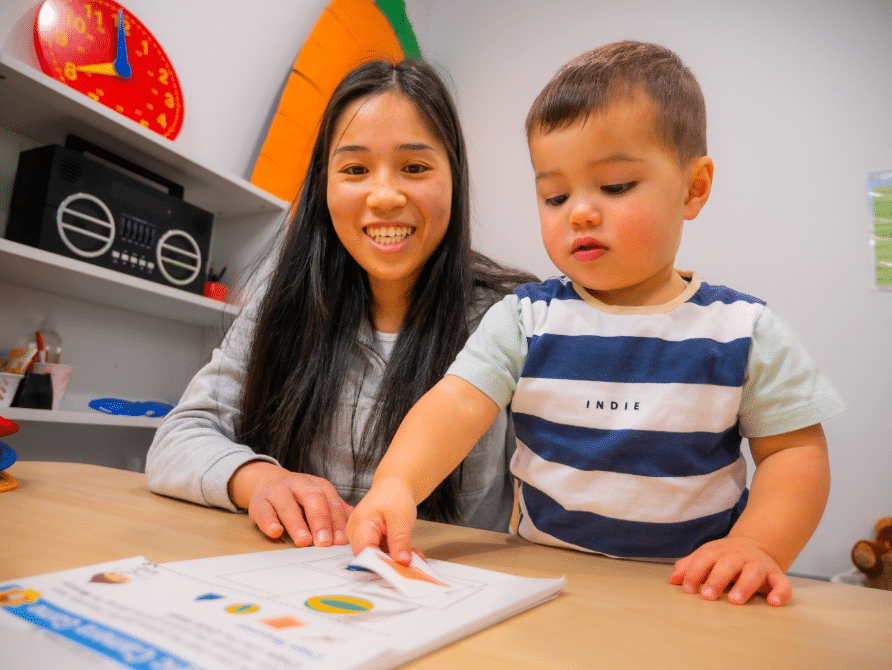
Sorting shapes is an effective way to develop preschoolers’ math skills. It also helps them distinguish between different objects. By utilizing 2-dimensional shape puzzles or shape cards, parents or educators can engage children in the process of identifying, sorting, and matching diverse shapes. This engaging activity not only enhances their shape recognition abilities but also introduces the concept of patterns, laying a solid foundation for their future learning endeavors. Through interactive play and exploration, children can actively participate in their educational journey, acquiring essential skills and knowledge that will pave the way for their academic success.
Creating patterns
Creating patterns with preschoolers is an effective method to introduce early math principles while nurturing their creativity. Begin with simple patterns such as ABAB (red-blue-red-blue) and ABBABB (yellow-blue-blue-yellow-blue-blue). Utilize toys, blocks, or various materials to establish patterns that your preschooler can mimic. Engaging in this type of activity also enhances memory and develops fine motor skills in young learners. It is a beneficial approach to support their cognitive and physical development during the early stages of education.

Engaging Activities for Learning Shapes and Patterns
1. Shape Identification and Exploration
Introducing various shapes, such as circles, triangles, and squares, is an effective way to cultivate preschoolers’ understanding of shapes and their ability to identify them. By starting with basic shapes like circles and squares, we can help children recognize these shapes in familiar objects. This hands-on learning experience enables kids to enhance their spatial intelligence, which plays a crucial role in their overall cognitive development. Engaging in activities for preschoolers that involve shape recognition provides a solid foundation for young learners, supporting their comprehension and exploration of the world around them.
Activity idea: Use common household items to highlight these shapes. For example, point out a circular clock, rectangular books, or triangular slices of pizza. You could also introduce the concept of size and comparison by asking, “Which of these shapes is bigger or smaller?” This teaches children to observe and categorize objects based on visual properties.
2. Sorting and Comparing Shapes
Use real-world objects like blocks, books, or snacks to compare and sort shapes based on size, color, or type. This will help children grasp mathematical relationships such as “bigger than” or “smaller than”. For example, they could identify rectangles in items like books, windows, or tabletops and discuss which is larger or smaller. Sorting shapes by size, color, or type teaches children about relationships and patterns.
Activity idea: Gather various objects of different shapes and sizes and ask the children to sort them. For example, they can sort objects by their shape (e.g., circles with circles, squares with squares) or by size (e.g., large circles with large circles, small squares with small squares). Discussing the relationships between the objects, such as “This square is bigger than this triangle,” also improves their understanding of spatial relationships.
3. Creating Shapes and Patterns
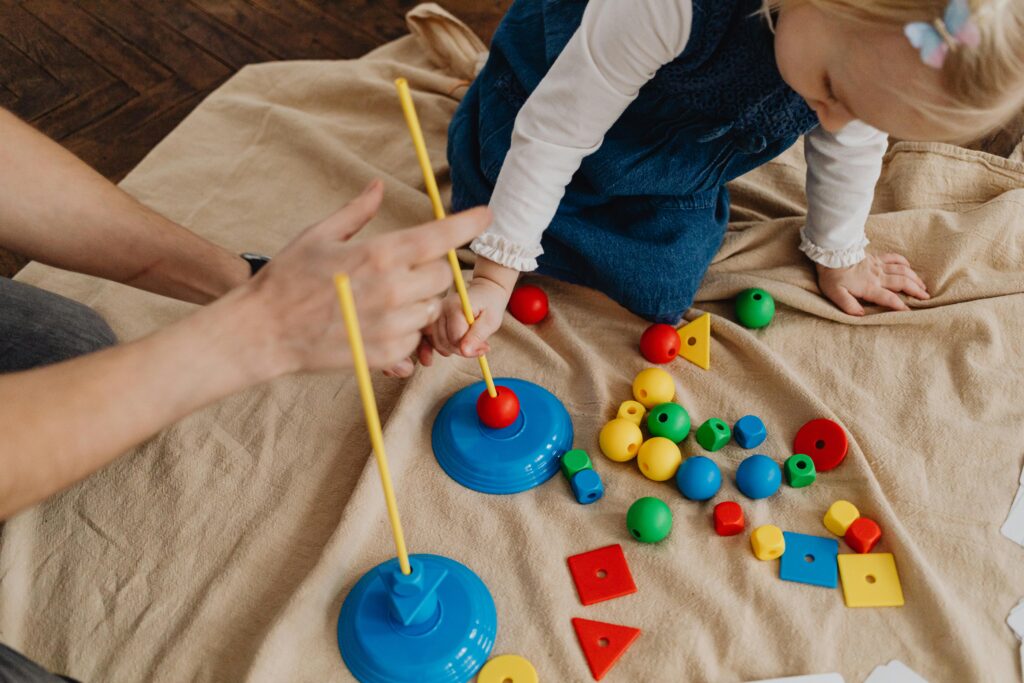
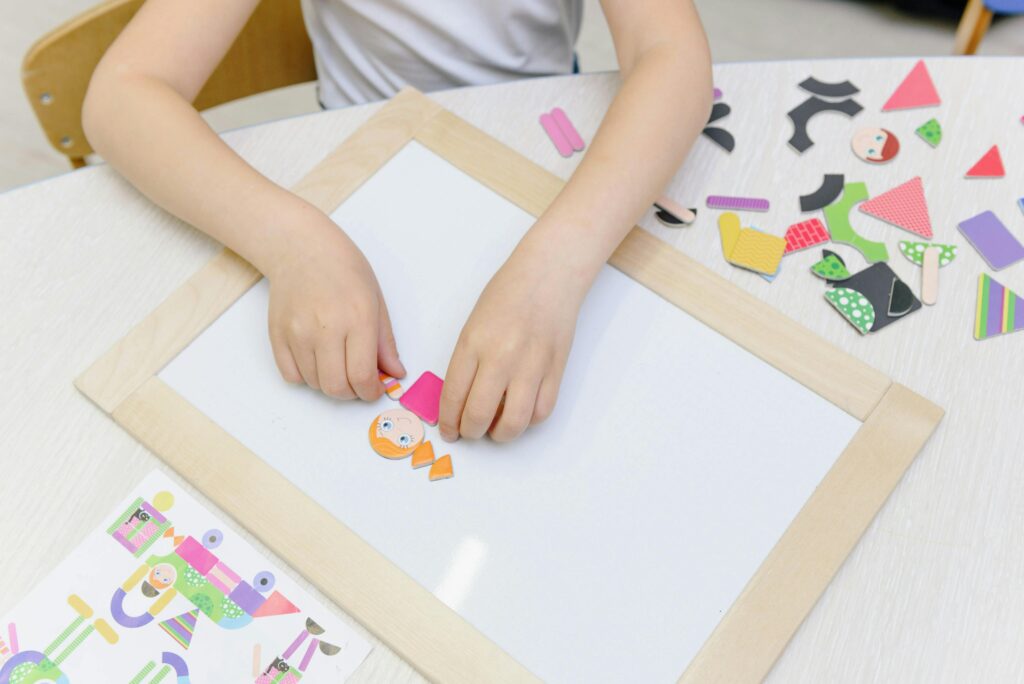
Hands-on activities that allow children to create shapes are incredibly valuable for solidifying their understanding. You can encourage them to form shapes using materials such as playdough, toothpicks, or craft sticks. This helps them visually and physically understand how shapes are constructed and how they can be combined to form new ones.
Activity idea: Let children build shapes using straws and clay or use a geoboard with rubber bands to form geometric shapes. For more advanced learners, challenge them to create patterns, such as alternating colors of blocks in a repeating sequence. Pattern activities not only reinforce shape recognition but also teach sequencing, an essential math skill.
4. Spatial Awareness and Transformation
Engage children in activities that involve rotating, flipping, or sliding shapes to develop their spatial awareness. angrams and pattern blocks are effective tools to encourage children to think critically about how shapes fit together. These activities also improve problem-solving skills and prepare children for geometric concepts.
Activity idea: Use tangrams, which are sets of geometric pieces that children can rearrange to form different pictures. Challenge them to rotate or flip the pieces to create various shapes or animals. Discuss the process of transformation by using words like “flip,” “turn,” and “slide” to describe their actions.
5. Connecting Shapes to the Real World
Another engaging activity is connecting the shapes children learn about in the classroom to those they encounter in the world around them. This connection reinforces their learning and makes it more meaningful.
Activity idea: Take children on a “shape hunt” in the home or outdoors. Look for shapes in architecture (e.g., rectangular doors, circular manhole covers), nature (e.g., triangular leaves, spherical fruit), or everyday objects (e.g., square windows, cylindrical bottles). Children can take pictures or draw what they find, creating a visual record of shapes in the world around them.
6. Using Technology to Enhance Learning: SHICHIDA at Home
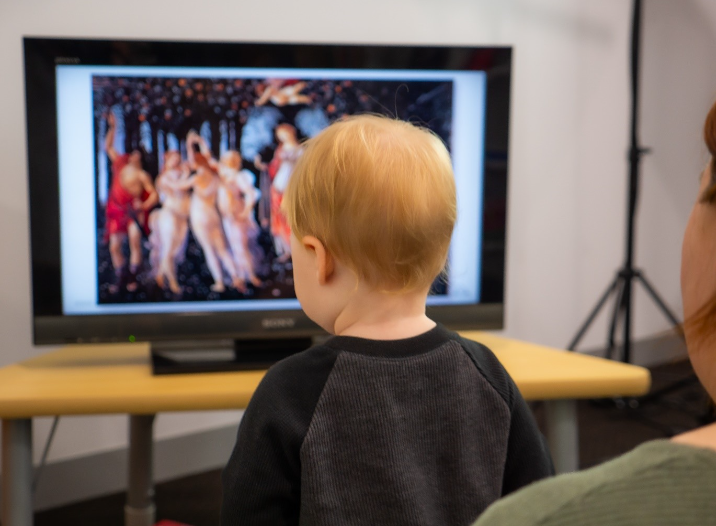
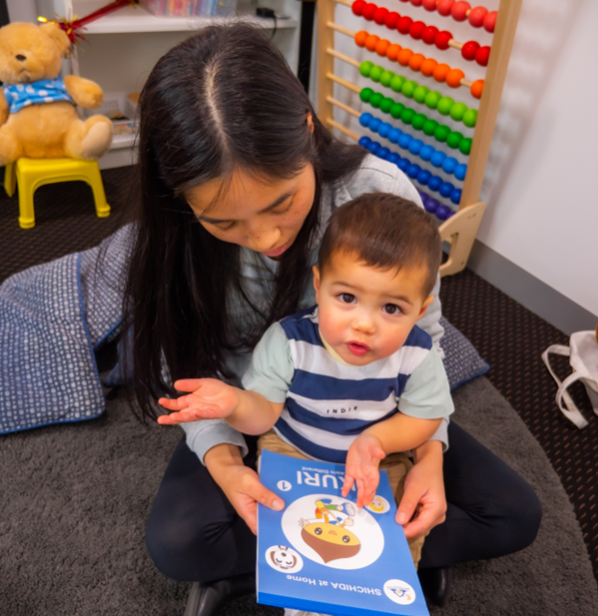
In today’s digital age, incorporating technology into early childhood learning can enhance the way preschoolers engage with shapes and patterns. SHICHIDA at Home’s online learning program offers a unique and interactive platform for parents and children, designed to complement traditional learning with dynamic, engaging content.
The SHICHIDA at Home program includes educational videos and online workbooks, that introduce shapes and patterns in a fun and accessible way. Through these resources, children can:
- Watch Engaging Videos: The SHICHIDA method uses a series of well-designed videos that teach shapes, colors, and patterns using vivid imagery and catchy music. These videos are carefully created to capture children’s attention while reinforcing key concepts through repetition and interactive elements.
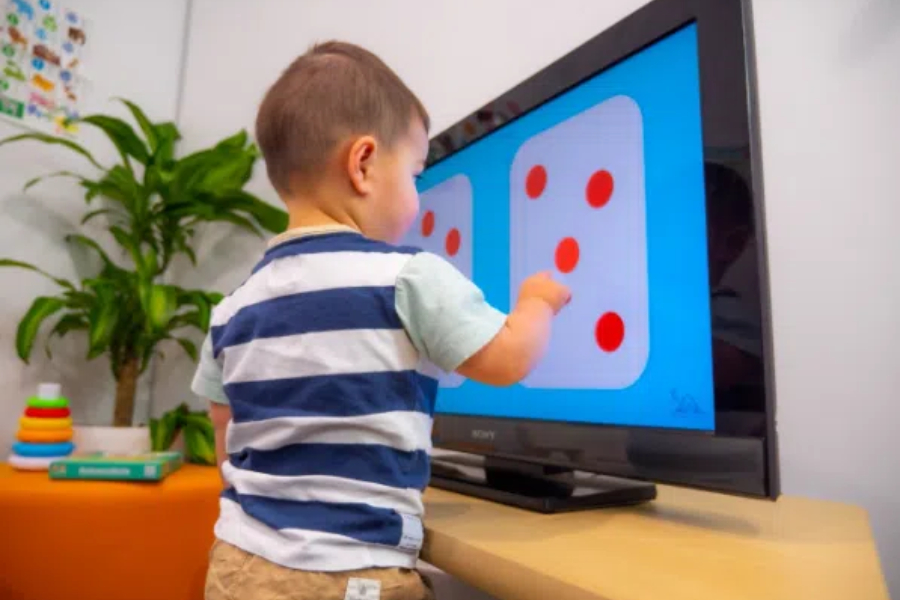
- Interactive Exercises: The program includes exercises where children can practice sorting shapes, identifying patterns, and completing puzzles that encourage them to recognize and create patterns in real time. These exercises are designed to keep children engaged while improving their shape and pattern recognition.
- Comprehensive Learning Approach: By incorporating both visual and auditory learning techniques, SHICHIDA at Home supports children in understanding shapes from multiple perspectives. The songs and activities are designed to build both cognitive and motor skills, encouraging children to not only recognize shapes but also interact with them through hands-on activities at home.
- Accessible Anytime, Anywhere: One of the key advantages of the SHICHIDA at Home program is its flexibility. Children can access the learning materials from any device, whether it’s a tablet, smartphone, or computer. This makes it easier for parents to integrate learning into daily routines and ensures that children can continue their shape and pattern lessons even outside of structured learning environments.
By leveraging technology through SHICHIDA at Home, parents can create a rich, interactive learning experience that enhances their child’s understanding of shapes and patterns. This not only supports mathematical development but also nurtures creativity, problem-solving, and cognitive flexibility.
Enhancing the Learning Environment
- Use Everyday Language
Incorporate shape-related terms such as “corner,” “edge,” and “side” during play. Encourage children to describe what they see and create, building their vocabulary. - Explore Shapes Outdoors
Take children on shape hunts outside, identifying objects like circular manhole covers, rectangular windows, or triangular signs. Capture photos of these items and discuss them later, creating a connection between learning and their environment. - Introduce Play-Based Tools
Use puzzles, geoboards, or interactive apps to engage children in hands-on learning. These tools not only teach shapes but also improve focus and concentration.
Incorporating shapes and patterns into daily indoor activities for kids not only supports mathematical growth but also nurtures creativity and critical thinking. With creative approaches like crafting, sorting, storytelling, outdoor exploration, and interactive tools, parents and teachers can create a rich learning experience that prepares preschoolers for future success in academics and beyond.